Sound and Timbre
Sound Innovations in the 20th Century / New Timbres
Electromechanical Sound Generation
In electromechanical sound generation, sound is produced through a combination of mechanical and electronic components. The devices created in this way are therefore also referred to as electromechanical musical instruments. The initial vibrations are generated mechanically. In a second step, the electronic components take over the acoustic pickup, processing and amplification of these initial vibrations.
The Electric Guitar
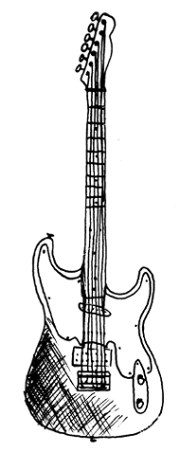
With the electric guitar, the sound is initially produced by the guitar strings. However, without amplification, it would be far too quiet. In classical (acoustic) guitars, the body, which is hollow inside and acts as a resonating chamber, amplifies the sound. With an electric guitar, the vibrations produced by the guitar strings must first be amplified.
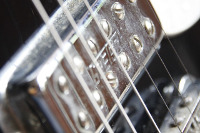
This is achieved by using pickups, which can convert the vibrations of the guitar strings into alternating voltage. A guitar pickup consists of a permanent magnet positioned underneath each guitar string and wrapped in very thin enamelled copper wire. The alternating voltage generated by the pickup can then be made clearly audible in the next step using a guitar amplifier.
Since this principle only works if the vibrations of the string can be detected by a magnet, the string itself must be made of magnetic material, such as nickel. An electric guitar would therefore never work with the strings of a classical guitar, as these are made of non-magnetic material (nylon).
Electric basses work according to the same principle and differ only in the thickness and number of strings found on standard instruments. Most electric basses have 4 strings, while most electric guitars have 6.
Audio example: Electric Guitar

All the electromechanical musical instruments presented here follow the same physical principle when it comes to sound pickup: electromagnetic induction.
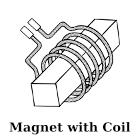
In electromagnetic induction, a coil is wound around a permanent magnet, with both ends of the coil connected to the amplifier. When an object moves above the magnet that can be attracted by a magnet (steel, copper, ...), electrons are pushed back and forth inside the coil. The resulting force is also called the Lorentz force. The vibrations generated in this way are made audible through amplification and transmission to a loudspeaker.
The Hammond Organ
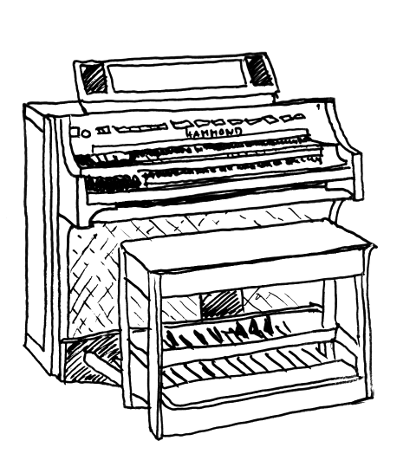
The Hammond organ is a musical instrument invented by Laurens Hammond in 1935. It has two manuals and a pedal bass, and was originally intended as a more portable alternative to the church organ.
The instrument follows a principle similar to that of the electric guitar.
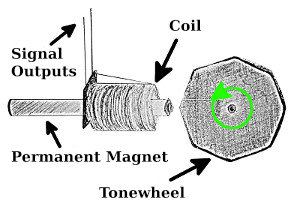
Here, too, mechanically generated vibrations are converted into alternating voltage using a permanent magnet wrapped in wire. Unlike the guitar, however, the vibrations are not produced by a string, but by a continuously rotating steel wheel.
Small notches are cut into the rotating wheel, causing the distance between the wheel and the permanent magnet to change periodically. This produces vibrations which, just as with the guitar, can then be amplified in a further step.
The Hammond organ is a musical instrument whose size and weight should not be underestimated. Its massive construction is partly due to the way it works. Each individual note to be produced requires its own wheel, which must have the appropriate number of notches to generate the desired frequency.
For example, if the note A' at 440 Hz is to be produced, the corresponding wheel must generate 440 vibration cycles per second. This can be achieved either by adjusting the rotational speed of the wheel or by changing the number of notches. Since all the wheels are driven together by a single motor, the only way to make this adjustment is by changing the number of notches.
Audio example: Hammond Organ
The Fender Rhodes - An Electromechanical Electric Piano
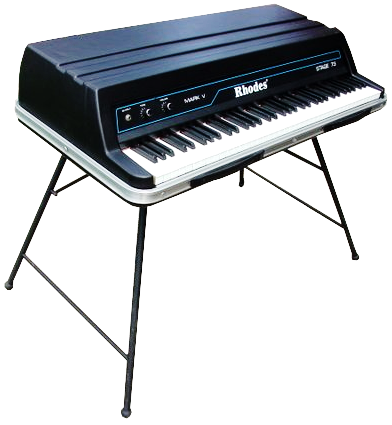
The Fender Rhodes is an electromechanical electric piano developed by Harold Rhodes in the 1960s. Its sound generation has nothing in common with that of modern digital electric pianos.
Inside the instrument are small tuning forks, which are struck by the keys via a mechanism fitted with a rubber-tipped hammer. Without amplification, the sound produced is somewhat similar to that of a glockenspiel.
For sound pickup, a permanent magnet and a coil are once again used for each note. The alternating voltage generated is also amplified by an internal unit.
Like the Hammond organ, this instrument is frequently used in jazz and is one of the most popular representatives of electromechanical electric pianos.
Audio example: Fender Rhodes
Generation of Synthetic Sounds
The Trautonium
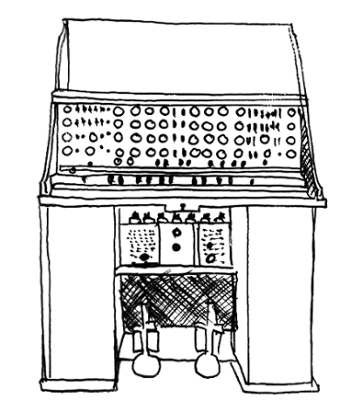
The Trautonium is a musical instrument designed by Friedrich Trautwein in 1930.
When radio became widespread in Central Europe in the late 1920s, many radio enthusiasts wanted a way to transmit music directly, without having to take the detour through a microphone. At that time, microphone quality was generally poor.
Inspired by this idea, Friedrich Trautwein developed the Trautonium. Unlike electromechanical musical instruments, Trautwein no longer used mechanical sound generation, but instead relied on purely electronic sound generation.
For this purpose, he used glow lamps, whose generated oscillations produce the characteristic Trautonium sound.
The inventor therefore did not use an electronic circuit designed exclusively to generate a tone. Instead, he used oscillations produced by lamps and made them audible in a further step through an amplifier. The Trautonium can therefore be considered a precursor of the (analogue) synthesizer.
One special feature of the Trautonium is the way it is played. Instead of a keyboard, it uses at least one touch-sensitive ribbon manual. This allows the instrument to be played continuously, meaning it can also produce, for example, quarter tones.
The playing technique is reminiscent of fingering the strings of a violin. Metal strips are mounted above the ribbon manual to help the player find the correct notes. The instrument's sound can be varied using built-in filters controlled by the two foot pedals.
The instrument attracted considerable attention from the composer Hindemith, who wrote several pieces for the Trautonium.
Example video of the Trautonium: A so-called Mixtur-Trautonium is used for improvisation.
The Synthesizer
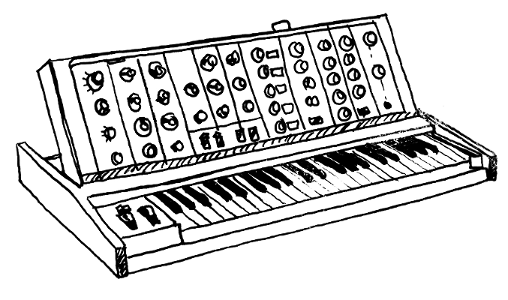
A synthesizer is a musical instrument capable of producing sounds and noises synthetically.
Every synthesizer requires at least one oscillator (also called OSC or VCO), since the instrument needs at least one tone generator. No oscillator, no sound or tone.
Almost all analogue and digital synthesizers use more than one oscillator. In digital synthesizers, the oscillators are programmed.
An oscillator is essentially a tone generator that produces oscillations. These can have different waveforms. You can see the four most important ones on the right-hand side next to this text. They can be identified by connecting the oscillator to an oscilloscope.
The oscillator is the most important component of a synthesizer. As soon as this electronic oscillating circuit is supplied with power, it immediately begins to oscillate at a specific frequency.
Most analogue synthesizers use a so-called VCO (short for "voltage-controlled oscillator"). The special feature of this component is that the pitch frequency changes according to the control voltage.
This means that when the oscillator is supplied with a higher voltage, the pitch frequency and therefore the resulting tone also increase (in everyday terms: 'more power to the oscillator means a higher pitch').
In practice, an oscillator can be used to generate all kinds of frequencies and therefore all kinds of notes at any desired pitch.
In addition to the oscillator, synthesizers normally contain several so-called modulators. These are additional electronic components that can modify the actual sound produced by the oscillator.
As a result, a synthesizer can produce sounds that resemble those of real wind, string or percussion instruments.
Like all devices that generate sound synthetically, synthesizers also need to be amplified.

Did you know that Mr Petri also enjoys making electronic music in his spare time? He mainly uses analogue synthesizers, although not exclusively. One of his friends focuses on drum synthesizers, meaning percussion instruments, while he himself is responsible for the melodies and chords.
Together, the two call themselves "Analogbrett". Their main focus is on danceable electronic music, also known as Electronic Dance Music (EDM). Perhaps you'll even enjoy their music!
Audio example: EDM - Analogbrett
Sampling Techniques / Digitalisation
Samples
"Sample" (English) means "a small representative portion" or "specimen". In music, the term refers to a short excerpt from a digitised audio recording.
This can be a passage from a piece of music or, for example, an individual note produced by a musical instrument or a short sound excerpt.
Editing and Assigning Samples
Once samples have been created by cutting excerpts from an audio recording, they can be used in a new piece of music. So-called samplers are used for this purpose.
These devices can assign individual samples to individual piano keys, for example, or assign one sample to several piano keys. Depending on which piano key is pressed, the pitch of the sample can be raised or lowered.
This process of raising or lowering the pitch of an original sound is also called pitching.
In practical terms, this means the following: Using pitching, it is possible to assign a sample of the guitar note A' to the A' key of a sampler and assign transposed versions of the original guitar sample, with higher or lower pitches, to all the other keys.
If you press the piano key B', the sampler plays the original guitar sample one semitone higher.
Instead of piano keys, samplers also frequently use pads. These are square, pressure-sensitive buttons that play the corresponding sample when pressed.
MIDI
MIDI (="Musical Instrument Digital Interface") is a digital interface for musical instruments that was invented in 1983. It makes it possible, for example, for a MIDI keyboard connected to a synthesizer to actually play that synthesizer. This is made possible by a protocol, the MIDI protocol, which precisely defines how information (which note, how loud the note should be, etc.) is transmitted.
For example, the note G'' ("G two octaves above middle C") has the value 55. Whenever the note G'' is played on a MIDI keyboard, the MIDI protocol ensures that the value 55 is transmitted to the synthesizer via the MIDI interface.
The MIDI protocol is therefore essentially a set of instructions explaining how information coming from the keyboard should be processed.
Besides MIDI keyboards, there are many other devices that have a MIDI interface and support the MIDI protocol.
Nowadays, computers can be equipped with MIDI very easily, meaning that saved MIDI files can also be sent directly to a synthesizer (or another MIDI-compatible device) and played back.
Sources: - Martin Koch: E-Gitarrenbau. 1999, S. 29. - Bernd Enders: Lexikon Musikelektronik. 1997, Mainz, S. 120f. - André Ruschowski: Elektronische Klänge und musikalische Entdeckungen. 2010, Stuttgart, S. 56-66.