Musical Scales
A musical scale is a specific and fixed sequence of notes arranged according to pitch. A scale is bounded by two notes that are an octave apart. Major and minor scales are among the most commonly used scales in Western music, particularly in classical and popular music. These are the scales we will focus on in the following sections.
The Major Scale
Let's take a look at the following C major scale:
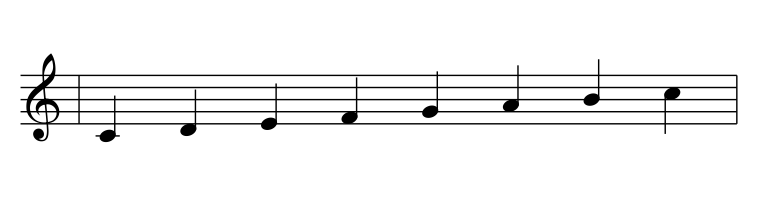
The scale consists of the notes C, D, E, F, G, A, B, and C again. However, the final C is one octave higher. Both C notes represent the same scale degree, called the tonic:
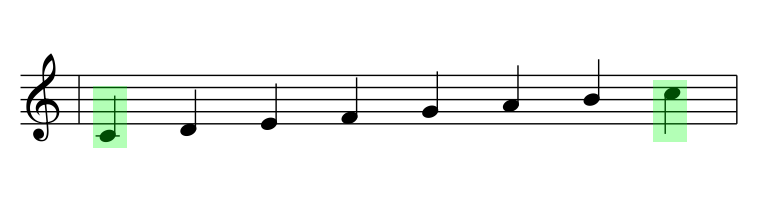
The tonic is the starting note and also gives the major scale its name: in this case, a C major scale.
All the other notes are arranged consecutively at intervals of a second, ascending towards the final note, the second C.
When determining the specific interval qualities of the notes using a piano keyboard, we can see that there are two minor seconds, and therefore two semitones, between E and F and between B and C:
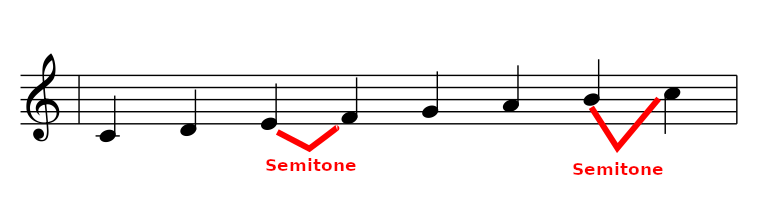
There are therefore semitones between the 3rd and 4th notes, as well as between the 7th and 8th notes. All the other intervals are major seconds, and therefore whole tones.
This pattern of whole tones interrupted by semitones between the 3rd and 4th notes and between the 7th and 8th notes applies to ALL major scales.
The Minor Scale
Let's take a look at the following A minor scale:
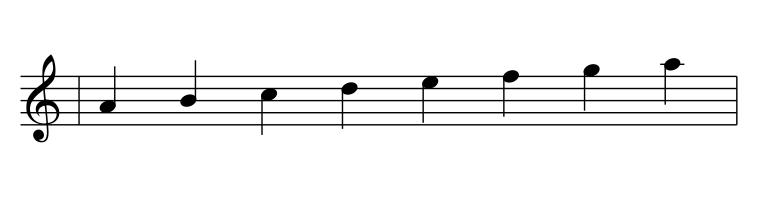
The scale consists of the notes A, B, C, D, E, F, G, and A, with the tonic A repeated again one octave higher.
Both A notes represent the same scale degree, called the tonic:
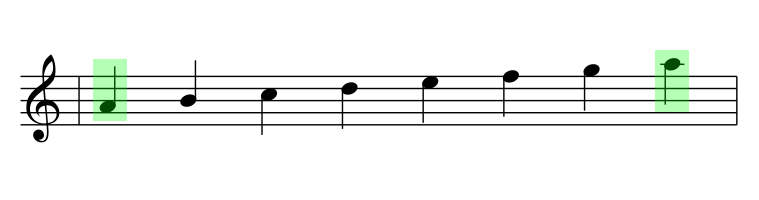
Next, let's take a look at the specific interval qualities:
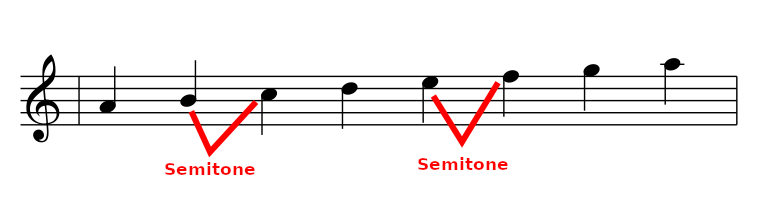
This time, the semitones occur at different positions than in the C major scale: between the 2nd and 3rd notes, and between the 5th and 6th notes.
This pattern of whole tones interrupted by semitones between the 2nd and 3rd notes and between the 5th and 6th notes applies to ALL minor scales.

If you remember that a scale without accidentals running from C to C is a MAJOR scale, and a scale without accidentals running from A to A is a MINOR scale, you can always use these examples to work out the positions of the semitones in each scale type (major or minor).
The positions of the semitones are always identical, regardless of the chosen key.
So, once we have established that the semitones in a C major scale occur between the 3rd and 4th notes and between the 7th and 8th notes, the same pattern also applies to F-sharp major, E-flat major, A major, and so on.
The same principle applies to minor scales and their semitones between the 2nd and 3rd notes and between the 5th and 6th notes.