Intervals
Intervals describe the distance in pitch between two notes. The following intervals are distinguished:

The unison is the first interval, the second is the second, the third is the third, the fourth is the fourth, the fifth is the fifth, the sixth is the sixth, the seventh is the seventh, and finally, the octave is the eighth interval.
Identifying Intervals
When identifying an interval, it is useful to distinguish between the generic interval and the specific interval quality. First, we determine the generic interval, followed by the specific interval quality.
When determining the generic interval, the written notation is what matters. Accidentals are irrelevant at this stage. We simply count the distance between two notes on the staff lines and spaces. It is important to remember that the starting note is included in the count. Let's take a look at the following example:
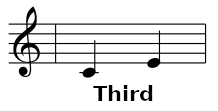
This is the generic interval of a third, because there are three steps in the written notation between the first note (C) and the second note (E), including the starting note.
By determining the generic interval, we establish the interval class. This always remains the same and cannot be changed! A third will always remain a third, a fifth will always remain a fifth, and so on.
The generic interval can therefore be determined exclusively by looking at the written notation. This applies to all possible notes:
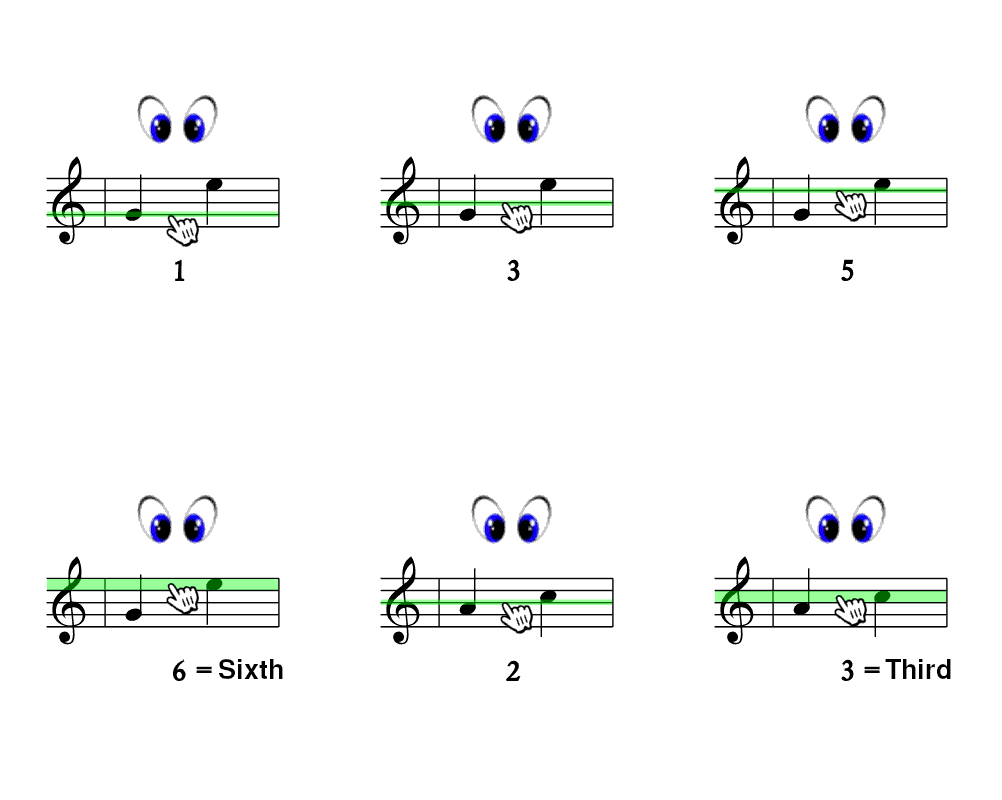
As you can see from these examples of a third and a sixth, the first step is simply to count the staff lines and spaces. You might be wondering why we include the starting note in the count. This is because intervals are named according to ordinal numbers. The unison is not the interval with a written distance of 1, but rather the FIRST interval. Since the unison, as the first interval, has a written distance of 0, the starting note must therefore be included in the count.
Once the generic interval has been determined, we have already completed half of the process of identifying an interval. We now turn our attention to the semitones in order to determine the specific interval quality.
A piano keyboard can be used for this purpose. It is important to note that we no longer count the starting note, but instead count the actual semitones between the two notes. Once we have counted them, we compare the result with the interval in question.
The following table shows which number of semitones corresponds to each interval quality.
| Semitones | Interval Quality |
|---|---|
| 0 | Perfect unison |
| 1 | Minor second |
| 2 | Major second |
| 3 | Minor third |
| 4 | Major third |
| 5 | Perfect fourth |
| 6 | Tritone |
| 7 | Perfect fifth |
| 8 | Minor sixth |
| 9 | Major sixth |
| 10 | Minor seventh |
| 11 | Major seventh |
| 12 | Perfect octave |
You might be wondering why the 6-semitone interval is treated differently in this list. We will get to that shortly.
In the illustration below, you can see how determining the generic interval is followed by determining the specific interval quality.
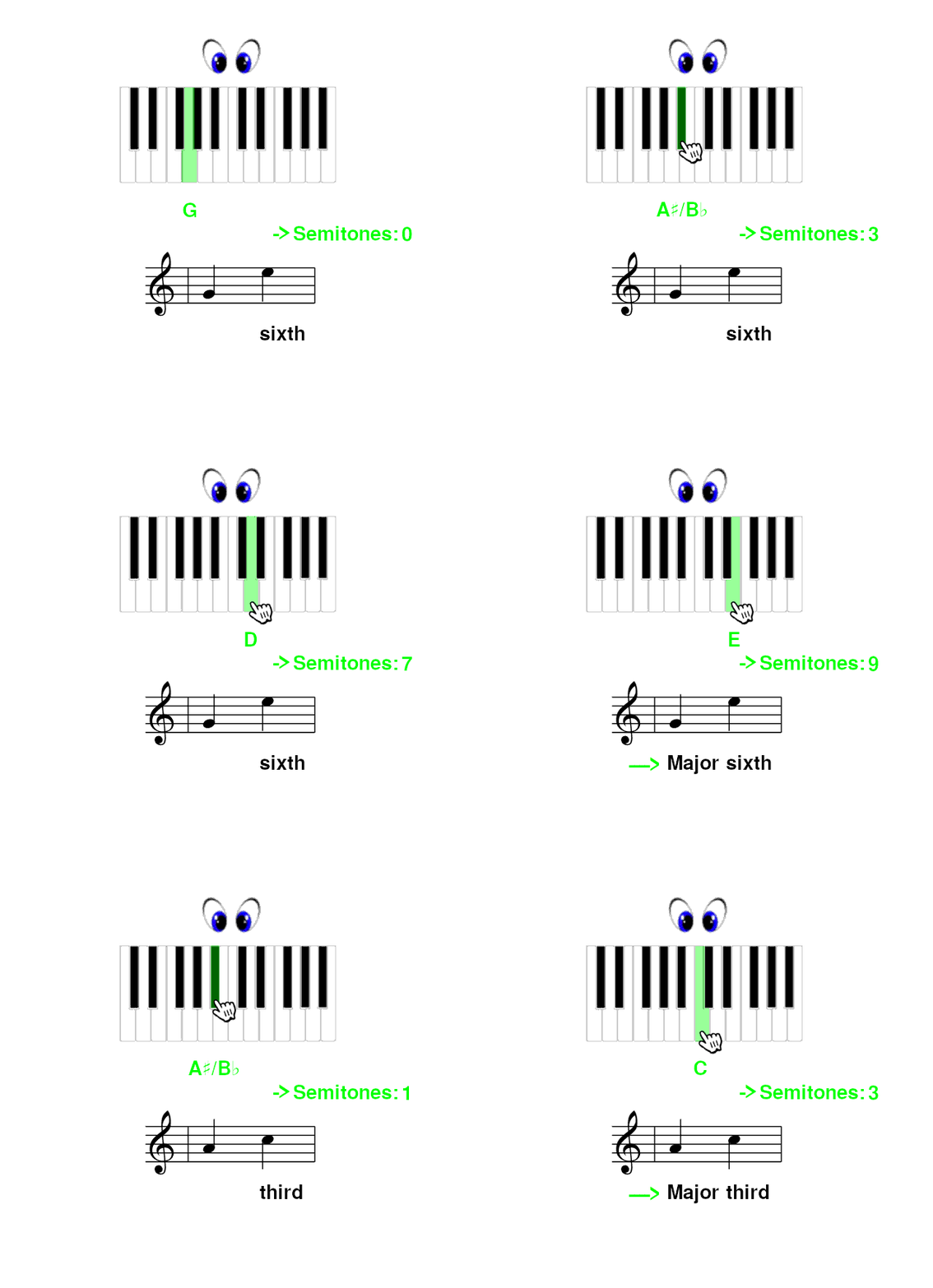
Some intervals can be 'major' or 'minor', while others are described as 'perfect'. Perfect intervals are the unison, fourth, fifth, and octave. Major or minor intervals are the second, third, sixth, and seventh. These are also called major/minor intervals, as they can be either major or minor.

There is a reason why this distinction might initially seem unusual: Perfect intervals are those in which you would notice less of a difference in sound if you played them simultaneously, compared to major or minor intervals.
Perfect intervals are therefore less easily distinguished from one another than major or minor intervals. This, in turn, has a reason that can be found in the harmonic series.
Every naturally occurring musical tone contains additional tones hidden within it, known as overtones. The overtones that we tend to hear most prominently (usually unconsciously) correspond to the perfect intervals relative to the respective fundamental note.
Constructing Intervals
You can now identify most intervals. Writing down intervals essentially works in the same way as identifying them:
-
Determine the generic interval: Starting from the initial note (← which is included in the count!), count the staff lines and spaces up to the desired interval. Then write down the corresponding note.
-
Determine the specific interval quality: Starting from the initial note (← which is not included in the count!), count the semitones on the piano keyboard and check whether they match the written notation. If they do not, the note must be corrected using accidentals.
Examples of Constructing Intervals
Example 1
We want to construct a perfect fourth upwards from the following note A' (pronounced "A one-line"):
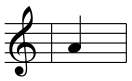
First, we determine the generic interval of a fourth. A fourth consists of 4 steps in the written notation. We include the starting note in our count and move 4 steps upwards. This gives us the following notation:
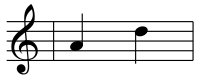
Next, we check the number of semitones between the note A' and the resulting note D'' (pronounced "D two-line"), because we now want to determine the specific interval quality.
We count a total of 5 semitones. According to the table above, a perfect fourth consists of 5 semitones. We therefore do not need to make any changes, and we have successfully constructed a correct perfect fourth.
Example 2
We want to construct a perfect fourth downwards from the following note B':
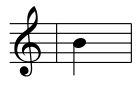
Once again, we first determine the generic interval. We count 4 steps in the written notation, but this time downwards. This gives us the following notation:
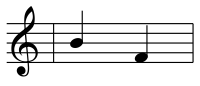
We check the number of semitones between the note B' and the resulting note F' to determine the specific interval quality. We find that there are 6 semitones.
However, according to the table, a perfect fourth consists of only 5 semitones. The resulting interval therefore has one semitone 'too many'.
To correct this, we need to raise the second note F'. A note is raised by using a sharp accidental (#).
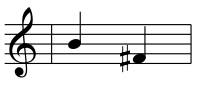
Remember that in this example we constructed an interval downwards. Accordingly, the distance between the two notes had to be reduced using a sharp accidental (#).
Conversely, a sharp (#) raises a note without an accidental when constructing an interval upwards! A flat (b), on the other hand, can increase or decrease the interval distance in the opposite direction.
Augmented and Diminished Intervals
There is one final step before we can identify and construct all possible intervals.
In addition to major/minor intervals and perfect intervals, there are also augmented and diminished intervals. These occur whenever the number of semitones determined during the specific interval quality calculation is greater or smaller than the values listed in the table.
The following order applies:
Perfect Intervals
Diminished < Perfect < Augmented
Major/Minor Intervals
Diminished < Minor < Major < Augmented
Accordingly, we get the following examples:
Example 1
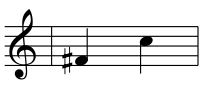
First, we determine the generic interval of a fifth. We then determine its specific interval quality.
We count a total of 6 semitones. However, a perfect fifth consists of 7 semitones. Since there is one semitone 'too few', this must be a diminished fifth.
Example 2
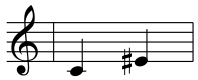
We determine the generic interval of a third. When determining the specific interval quality, we count a total of 5 semitones.
However, a major third consists of only 4 semitones. Since there is one semitone 'too many', this must be an augmented third.
The Tritone
We can now also answer the question of why the entry for 6 semitones in the table for determining the specific interval quality is treated differently.
An interval consisting of 6 semitones can only be either a diminished fifth or an augmented fourth.
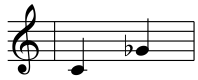
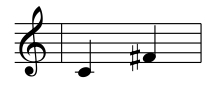
This special interval has its own name: the tritone (from the Greek word meaning "three tones", because the interval consists of 3 whole tones = 6 semitones).
This is the only exception in which two intervals with different written notation (a generic fifth and a generic fourth!) share the same name.
In all other cases, the generic interval determines the name, regardless of whether the same number of semitones results when determining the specific interval quality!
Nevertheless, the terms 'augmented fourth' and 'diminished fifth' would not be incorrect for the respective intervals. However, the term 'tritone' is more commonly used.