New Simplicity
With the emergence of New Music around 1910 and structure-oriented serial music after the Second World War, it became practically impossible for composers to devote themselves extensively to traditional forms such as the symphony or sonata without being regarded as traditionalists themselves.
As has often happened throughout history, the musical world reacted in a way that was almost inevitable: the strong focus on atonal music led to a counterreaction in the mid-1960s. Initially cautiously, but then increasingly consistently, many composers began writing tonal music again. It was once again acceptable to write music that was fully aware of its own 'beauty'.
A new musical style emerged, based on this compositional approach and its use of tonal and traditionally oriented musical material: New Simplicity (in german: Neue Einfachheit).
This music is characterized by simple tonal material and often conveys a meditative atmosphere. This was partly influenced by the growing fascination with Eastern philosophy in the Western world from the 1960s onwards. Composers became interested in various forms of spiritual and alternative thought. Some increasingly explored overtones or so-called ragas – Indian scale systems that, unlike those commonly used in Central European music, function relatively rather than absolutely. This means that the scale can change while an instrument is being played.
One example of a composer who composed and continues to compose in the style of New Simplicity is Arvo Pärt. Born in Estonia in 1935, the composer turned to medieval music in the mid-1970s after spending many years working with serial music.
This exploration led to the development of the so-called Tintinnabuli style (tintinnabulum, Latin for "bell" or "small bell", referring to bells used in Roman Catholic processions).
In this technique, different notes from a scale in one voice are assigned corresponding notes in another voice. Together, these notes form a triad.
The following is an example of such a combination:
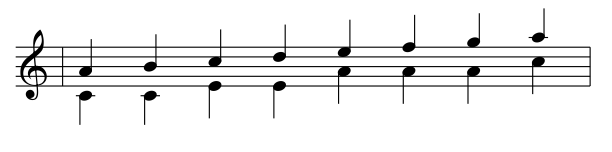
As you can see, the upper voice consists of an ascending A minor scale, to which notes from an A minor chord (A, C, E) are assigned.
When a melody based on the scale is composed, notes from the triad are added according to the previously established assignment. However, this procedure can also be reversed. In that case, notes from the corresponding scale are assigned to a voice based on the notes of a triad.
Not all of Pärt's works associated with New Simplicity, however, follow this particular compositional technique.
One of Pärt's best-known works composed using the Tintinnabuli style is "Für Alina":
Example of Arvo Pärt's Tintinnabuli compositional technique: Für Alina
Sources: - Raeburn, Michael, und Michael Raeburn. Das 20. Jahrhundert. Geschichte der Musik, hrsg. von Michael Raeburn und Alan Kendall; 2. München: Kindler [u.a.], 1993, S. 216–221, 367.