Reading and Writing Musical Notes
The Natural Notes
Before we can write musical notes, we first need to learn their names. There are seven so-called natural notes:
C D E F G A B
This sequence of natural notes repeats both upwards and downwards. Below C, we therefore have B, A, G, and so on. In other words, we read the sequence of natural notes backwards. Above B, we have C, D, E, and so on, continuing the sequence forwards.
To write down these natural notes, meaning to represent them in musical notation, music uses a five-line system.

These are called staff lines and spaces, referring to the areas between the lines. Let's take a look at the following example of a note on the staff:
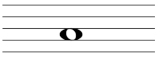
Someone who plays a musical instrument might say that this is an A. However, that is only true under certain circumstances.
In this case, the note is actually a C:
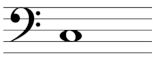
Now the note is a B:
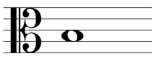
And only now is the note an A:
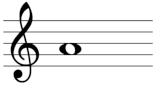
The note represented on the staff therefore depends on which symbol appears before the notes. This symbol is called a clef.
The Clef
The clef determines how notes on the staff are to be interpreted. It therefore determines which pitch is represented.
The two most important clefs are the bass clef and the treble clef.
The treble clef is also called the G clef. It developed from a handwritten letter G into its current shape. Its starting point indicates the G on the second line from the bottom.

Starting from this G, all the other notes are determined. They alternate between the staff lines and the spaces.
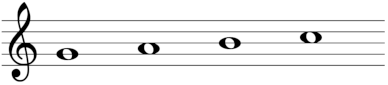
When a note moves upwards, its pitch also increases. Starting from the G on the second line from the bottom, since we are looking at a treble clef, we get the notes A, B, and C:
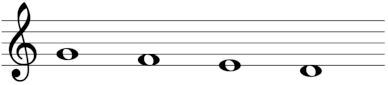
When a note moves downwards, its pitch decreases. Starting from G, we then read F, E, and D.
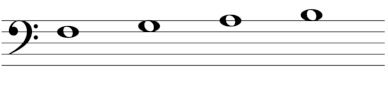
The same principle applies to the bass clef, with the difference that it developed from a handwritten letter F and therefore indicates an F. This note is located on the second line from the top, between the two dots:

When a note moves upwards here, its pitch increases. This time, we start with F, followed by G, A, and B.
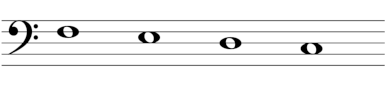
When notes move downwards, the following notes are E, D, and C.
Ledger Lines
Sometimes notes are so high or so low that they no longer fit within the five-line staff. In these cases, additional lines are added directly above or below the staff, extending it around the note. This works in both directions.
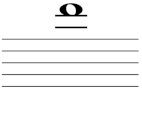
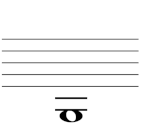
Ledger lines work in exactly the same way for all clefs.
Being able to read and write musical notes is comparable to learning how to read and write text. It allows us to understand music more clearly, perform it ourselves, and, beyond that, think about music without having to listen to the same passages of a piece over and over again.
Musical notation allows us to take our time and think about a piece of music because the entire work is visually represented in front of us.