The Synthesizer – An Introduction
A synthesizer is a musical instrument that can electronically generate sounds and noises. To understand exactly how a synthesizer works, it makes sense to start by looking at the simplest form of a synthesizer:
How Sound Is Created – The Oscillator
A synthesizer starts with an oscillator, which essentially does nothing more than generate a specific oscillation periodically (i.e. continuously repeating). But what exactly does that mean?
We are all familiar with oscillations, for example when skipping rope: the rope is set into a repeating oscillating motion, and the person standing in the middle has to jump over it at just the right moment.
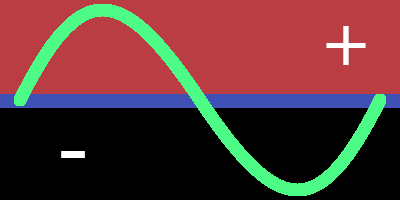
An oscillator works in much the same way: it sets something into oscillation, but instead of a skipping rope, it is electric current. This happens in such a way that the current alternates between two directions. First, it flows in one direction, then in the other. Let's look at a simple example:
This is one complete sine wave:

If we divide the wave horizontally along the middle, the resulting line corresponds exactly to the point at which no current flows at all. As soon as the wave is above this zero point, the current flows in one direction (+). As soon as it is below this zero point, the current flows in the opposite direction (-).
But what is the point of all this physical information? It now becomes much easier to understand how a synthesizer actually produces sounds. Once we understand that an oscillator does nothing more than generate an electrical oscillation that regularly changes the direction of current flow, it is easy to explain how this produces something we can hear:
From the Oscillator to the Audible Result
A loudspeaker essentially consists of a diaphragm with a coil attached to it, positioned in front of a strong magnet. When electric current flows through this coil, it becomes magnetic, with the polarity depending on the direction of the current. Depending on the direction, the diaphragm moves either forwards or backwards. This means that a loudspeaker is set into motion by electric current, provided that the current itself regularly changes direction and therefore also oscillates.
As we have already established, an oscillator does exactly that: it generates an oscillation in which the direction of electric current regularly changes. If we now connect such an oscillator to a loudspeaker, the loudspeaker diaphragm begins to oscillate at exactly the same frequency as the oscillator itself.
We then hear a sound because the vibrating loudspeaker diaphragm causes the surrounding air to vibrate, and our ears can detect these vibrations. We measure the speed of these oscillations in Hertz, where one Hertz (1 Hz) corresponds to one oscillation per second.
You can try this out for yourself right here. Observe how the frequency of the oscillation changes in the oscilloscope and how the speed of the loudspeaker diaphragm changes as well. Also note that you can choose between different types of oscillations, known as waveforms. But more on that in a moment.
Waveforms
In synthesizers, we generally distinguish between four different waveforms:
Sine Wave
Square Wave

Sawtooth Wave

Triangle Wave

These waveforms sound very different because they cause the air to vibrate in different ways.
The sine wave plays a special role here: All sounds have one thing in common: they are made up not just of a single oscillation, but also of additional partial oscillations – with the exception of the sine wave.
This means that whenever we hear a sound, we can assume that other oscillations are present alongside the main one. The only exception is an (ideal) sine wave, in which case we really hear just a single oscillation.
We can represent this graphically by breaking down the resulting sounds into their individual oscillations. This is done using a technique called FFT, which stands for Fast Fourier Transform. It allows us to see which additional oscillations, also known as frequencies, are present in a sound.
You can explore this for yourself here. Notice that the sine wave is the only waveform without any additional partial oscillations, and that for all the other waveforms, the partial oscillations become quieter as their frequency increases:
When the synthesizer's volume is turned up, the amplitude of the respective waveform increases. Conversely, when the volume is turned down, the amplitude decreases as well.
The frequency, on the other hand, determines how fast the wave oscillates. Higher frequencies therefore produce more waves within the same period of time (one complete wave is called a cycle).