Notating Rhythms
To notate a rhythm, we first need a point of reference to determine how fast or slow the rhythm should be interpreted.
The Pulse
In music, this reference is called the pulse. It runs continuously at a regular rate and serves as the foundation for the rhythm.
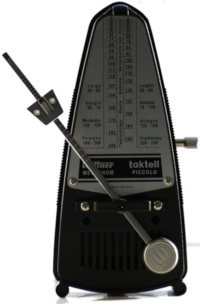
A metronome is a pulse generator. It is primarily used to determine how fast a particular piece of music should be played, as its tempo can be set and read. Once the pulse and its tempo have been established, rhythms can be created around it.
To provide a clear structure, the pulse is divided into units called bars (or measures). In 4/4 time, for example, the pulse is divided into four beats, so you always count from 1 to 4 before starting over. These numbered units are called beats.
Simple Quarter-Note and Eighth-Note Rhythms
Once we take the pulse into account, we can use a table to notate simple rhythms by simply counting the impulses within each beat:
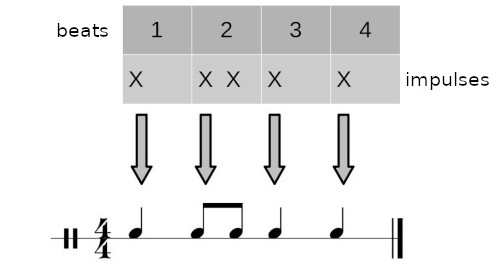
From this list, we can see that when one impulse is played on a beat, it is represented by a filled notehead with a vertical stem (beats 1, 3, and 4).
Two impulses within a single beat, on the other hand, are represented by two notes, each with a filled notehead and a vertical stem. They also have flags, which in this case are connected to each other (beat 2).